


JULY 2024 SCREENING COMPLIANCE UPDATE
ClearStar is happy to share the below industry related articles written by subject matter experts and published on the internet in order to assist you in establishing and keeping a compliant background screening program. To subscribe to the Screening Compliance Update or to view past updates, please visit www.clearstar.net/category/screening-compliance-update/.
EXECUTIVE SUMMARY
The screening compliance landscape recently witnessed some major changes that have been documented in the JULY 2024 SCREENING COMPLIANCE UPDATE. Below is an EXECUTIVE SUMMARY of some of the new developments at the FEDERAL, STATE, and INTERNATIONAL levels.
- FEDERAL DEVELOPMENTS: The U.S. Department of Transportation (DOT) confirmed that the U.S. Department of Justice’s (DOJ) proposal to reschedule marijuana from a Schedule I to a Schedule III drug will not impact the transportation industry’s ability to screen for marijuana.
- STATE DEVELOPMENTS: The District of Columbia (D.C.), Maryland, and Vermont have enacted pay transparency laws to join a growing number of states including California, Colorado, Illinois, New York, and Washington in an effort to address pay disparity in the workplace.
- INTERNATIONAL DEVELOPMENTS: On July 1, 2024, a new agreement between the European Union (EU) and Japan called the “Data Flow Agreement” that facilitates data flows between the two jurisdictions entered into force.
I hope you find the JULY 2024 SCREENING COMPLIANCE UPDATE both informative and helpful in keeping up with establishing and maintaining a compliant background screening program.
Nicolas S. Dufour
ClearStar Executive Vice President, General Counsel & Corporate Secretary
FEDERAL DEVELOPMENTS
USDOT Clarifies Marijuana Testing Requirements Should Remain Intact Regardless of Reclassification
During a House Committee on Transportation & Infrastructure hearing today, U.S. Department of Transportation Secretary Pete Buttigieg confirmed that his agency believes that the U.S. Department of Justice’s proposal to reschedule marijuana from a Schedule I to a Schedule III drug will not impact the transportation industry’s ability to screen for marijuana.
Secretary Buttigieg directed his comments to Congressman Rick Crawford (R-Arkansas), who cited two letters that the American Trucking Associations has sent to federal agencies seeking clarity on this major policy shift that could have negative consequences for highway safety.
“We are grateful to Congressman Crawford for elevating this serious issue, and we appreciate Secretary Buttigieg’s focus on providing the transportation industry with the clarity it needs to continue screening for marijuana use among safety-sensitive transportation workers,” said American Trucking Associations President & CEO Chris Spear. “If the trucking industry’s ability to conduct drug testing for marijuana use were to be restricted, a heightened risk of impaired drivers would threaten our nation’s roadways. DOT and ATA share the goals of achieving zero highway fatalities and ensuring the commercial driving workforce is qualified to safely operate, which is why we are committed to partnering with DOT to mitigate harmful impacts caused by the potential reclassification of marijuana.”
Marijuana and alcohol remain the most detected drugs in impaired driving crashes resulting in serious or fatal injuries. Between 2000 and 2018, crash deaths involving marijuana more than doubled, from 9% to 21.5%. Immediately following Canada’s 2018 legalization of marijuana, the country’s emergency rooms saw a 94% increase in the rate of marijuana-involved traffic injuries.
In response to Congressman Crawford’s line of questioning today, Secretary Buttigieg explicitly stated that USDOT anticipates that it will maintain the authority to conduct testing of marijuana use by commercial motor vehicle drivers and other safety-sensitive transportation workers.
“The American Trucking Associations has transmitted two letters to your agency highlighting [reclassification] concerns,” said Congressman Crawford. “Mr. Secretary, I think it’s safe to assume that the number of all impaired drivers on our roadways would increase. Can you speak to what your Department is doing to ensure that transportation workers in safety reliant positions can continue to be tested for marijuana use if this proposal goes forward and how your Department plans to address transportation safety in light of DOJ’s ruling?
“Our understanding of the rescheduling of marijuana from Schedule I to Schedule III is that it would not alter DOT’s marijuana testing requirements with respect to the regulated community,” said Secretary Buttigieg. “For private individuals who are performing safety-sensitive functions, subject to drug testing, marijuana is identified by name, not by reference to one of those classes. So even if it was in its classification, we do not believe that that would have a direct impact on that authority.”
EEOC Focuses on Eliminating Harassment, Recruitment and Hiring Barriers in the Construction Industry
The Equal Employment Opportunity Commission (EEOC), whose mission is to enforce the nation’s anti-discrimination laws, released new guidelines on June 18, 2024, entitled Promising Practices for Preventing Harassment in the Construction Industry. The guidelines are in support of its Strategic Enforcement Plan for the fiscal years 2024-2028 for combatting systemic harassment and eliminating barriers in recruitment and hiring in the construction industry. With these guidelines, the EEOC has identified harassment as an ongoing issue in the construction industry, and that immediate attention and resolution is required.
The EEOC specifically recommends that the following five core principles that it has found effective in preventing and addressing harassment be implemented by construction industry employers:
- Committed and engaged leadership;
- Consistent and demonstrated accountability;
- Strong and comprehensive harassment policies;
- Trusted and accessible complaint procedures; and
- Regular, interactive training tailored to the audience and the organization.
The EEOC defines each of the core principles as follows.
1. Leadership and Accountability
The leadership and accountability core principles are based on the concept that the cornerstone of a successful harassment prevention strategy is leadership’s consistent and demonstrated commitment to create and maintain a culture in which harassment is not acceptable. Worksite leaders—from the project owner to crew leaders to union stewards—should clearly, frequently, and unequivocally message and demonstrate that harassment is prohibited.
2. Strong and Comprehensive Harassment Policies
A comprehensive, clear policy against harassment sets forth the behaviors that are unacceptable in the workplace, the procedures workers are encouraged to follow when reporting harassment, and the steps that the employer will follow when responding to complaints or reports of harassment.
3. Trusted and Accessible Complaint Procedure
In the construction context, the complexity of the multiple employer/entity environment introduces challenges to traditional reporting structures, but also presents opportunities to turn multiple channels into a “no wrong door” environment. While each onsite employer should have its own complaint system, the general contractor may also wish to coordinate supplemental channels that are available to workers regardless of their employer of record. Additionally, registered apprentices should be able to report harassment to their program sponsor.
An effective harassment complaint system welcomes questions, concerns, and complaints; encourages employees to report potentially problematic conduct early; treats alleged targets of harassment, complainants, witnesses, alleged harassers, and others with respect; operates promptly, thoroughly, and impartially; and imposes appropriate consequences for harassment or related misconduct, such as retaliation.
4. Effective Harassment Training
The EEOC determined that regular, interactive, and comprehensive training of all workers on a construction site can help ensure that the workforce understands applicable rules, policies, procedures, and expectations, as well as the consequences of misconduct. Training should be provided in a clear, easy to understand style in all languages that onsite workers commonly use.
STATE, CITY, COUNTY AND MUNICIPAL DEVELOPMENTS
District of Columbia and Maryland Address Pay Disparity Through New Transparency Laws
Executive Summary: Washington, D.C. and Maryland recently enacted pay transparency and wage history laws. In passing these laws, the two jurisdictions join a growing number of states including California, Colorado, Illinois, New York, and Washington in an effort to address pay disparity in the workplace.
WASHINGTON, D.C.
Washington, D.C. published DC Act 25-367 on March 5, 2024. The Act amends the Wage Transparency Act of 2014 and prohibits screening potential employees based on wage history or requesting wage history, expands on the current prohibition of employer policies and procedures that require employees to refrain from discussing their wages, requires employers to provide minimum and maximum pay ranges, and requires employers to disclose health benefits to prospective employees before the first interview. The Act applies to any employer that has at least one employee working in D.C.
The Act went into effect on June 30, 2024.
Pay range, Healthcare Benefits Disclosure, and Wage History Requirements
The Act requires employers to include the minimum and maximum projected salary or hourly wage in all job postings. The minimum and maximum provided must be that which the employer “in good faith” believes would be the actual range for the posted position. Notably, this requirement applies to external job postings as well as promotions and transfers for internal candidates.
Employers are also required to disclose the existence of health benefits to prospective employees “before the first interview.” If the employer fails to make such disclosures, a prospective employee can request the pay range or benefit information, and an employer would be required to disclose.
- Employers cannot screen job applicants based on wage history.
- Employers must post a notice in the workplace notifying employees of their rights under this law in a “conspicuous place in at least one location where employees congregate.”
This Act also prohibits employers from screening prospective employees based on their wage history. As such, an employer may not ask an applicant or the applicant’s previous employers questions related to their previous salary or hourly wage during the interview process or require that an applicant’s wage history satisfy the minimum or maximum salary or hourly wage range. The Act is silent on whether an employer can ask a prospective employee what their salary expectations are.
Enforcement:
The Act does not provide a private right of action for employees, but the attorney general has the authority to investigate violations and to bring civil actions against an employer or seek remedies on behalf of individuals or the public. If found to be in violation, an employer may be subject to civil fines ranging from $1,000 – $20,000 per occurrence.
MARYLAND
On April 25, 2024, Maryland Governor Moore signed Senate Bill 525/HB 649. The law applies to all employers (or persons who act directly or indirectly with an employee on behalf of another employer) that engage “in a business, industry, profession, trade, or other enterprise in” Maryland. There is no minimum employee requirement for coverage under this law.
The amendment takes effect on October 1, 2024.
Pay Transparency and Record Keeping Requirements
The amendment requires employers to include wage ranges in internal and external postings for positions that will be physically performed, at least in part, in the state of Maryland. Employers must set the wage range in “good faith.” Under the new law, “wage range” is defined as 1) the minimum and maximum hourly rate or salary set by reference to any applicable pay scale, 2) any previously determined minimum and maximum hourly rate or salary for the position, 3) the minimum and maximum hourly rate or salary of any individual holding a comparable position at the time of posting, or 4) the budgeted amount for the position.
Employers can comply with this requirement by using a state-provided form that will presumably be available by October 1, 2024.
Along with the requirement to provide a good faith wage range, employers are also required to disclose: a “general description of benefits” and “any other compensation offered for the position.” Where no public or internal job posting is made for a given position, the employer must disclose the three components identified above to applicants: (i) before any discussion of compensation with the applicant; or (ii) at any other time upon the applicant’s request. As with D.C., the Act is silent on whether an employer can ask a prospective employee what their salary expectations are.
Employers will be required to maintain records of employee wages, job classifications, and other conditions of employment for at least 3 years after a position is filled, or if the position is not filled, for at least 3 years after the position was initially posted.
Enforcement
The Act does not provide for private right of action for employees or applicants. Instead, the Maryland Department of Labor is authorized to impose the following penalties:
- First violation: issue an order compelling compliance with the law.
- Second violation: at the Maryland DOL’s discretion, employers may be assessed a civil penalty of up to $300 for each employee or applicant for employment for whom the employer is not in compliance.
- For each subsequent violation within three years, the amount of the civil penalty may increase up to $600.
Next steps
All employers should consider conducting the following due diligence:
- Review job postings and advertisements to ensure compliance;
- Consider conducting a pay equity audit to ensure that pay setting practices are compliant with all federal and state equal pay laws;
- Evaluate all interviewing and hiring material;
- Train all personnel on the updated requirements.
Employers with operations in California are all too familiar with how state and local officials continue to restrict the access employers have to public records, including criminal history information.1 For example, lengthy delays in completing standard criminal background checks are now routine in California.2 Apart from criminal background checks, many employers rely on motor vehicle record checks (MVRs) to vet candidates for positions that require driving as part of the job. In Doe v. California Dept. of Motor Vehicles, the court of appeal rejected the plaintiffs’ efforts to enjoin the Department of Motor Vehicles (DMV) from releasing information about the reason for a driver’s alcohol-impaired driving license suspension (e.g., the driver had an excessive blood-alcohol level) when the driver has not been convicted. Reversing the trial court, the court of appeal held the disclosure of such information does not constitute the disclosure of information about a non-conviction arrest within the meaning of California’s privacy laws. This is a rare “win” for employers in the Golden State.
Public Driver Records
The DMV discloses parts of an individual’s driving record, known as the “public driver record,” to specific entities under defined circumstances. This record includes the driver’s name, identifying details like eye color and height, and license number, class, and current status. Additionally, it features sections such as “Departmental Actions,” “Convictions,” “Failures to Appear,” and “Accidents.” In this case, the court of appeal considered the privacy implications surrounding DMV disclosures of alcohol-impaired driving license suspensions, generally known as Administrative Per Se (APS) suspensions.3 The court of appeal addressed whether disclosing the reason for such suspensions – such as excessive blood-alcohol levels – violates privacy laws when no criminal conviction exists.
The Trial Court’s Injunction Against the DMV
The plaintiffs alleged that this practice breaches privacy protections against disclosing non-conviction arrests. The trial court ruled for the plaintiffs, in part, finding that the DMV’s disclosure of the reason for an APS suspension for which there was no corresponding conviction violated the constitutional right to privacy of noncommercial drivers, but not of commercial drivers, and violated Labor Code section 432.7. The trial court also found the DMV violated the Information Practices Act. The trial court issued a judgment enjoining DMV from the improper practices.
The Court of Appeal’s Ruling Reversing the Trial Court
The court of appeal reversed the trial court, in part, including the injunction. The court of appeal determined that the public driver record does not directly disclose the arrest itself but instead reveals the administrative adjudication results, such as “Excessive Blood Alcohol Level” or “Refused Chemical Test.” The APS suspension process involves several steps, including an arrest, an officer’s sworn report, and a potential evidentiary hearing, leading to the DMV’s final determination. This process distinguishes the suspension from mere arrest information because it results from an independent administrative adjudication rather than being solely arrest-based. Furthermore, the process necessitates proof by a preponderance of the evidence, a higher standard than probable cause—the standard for an arrest. The court of appeal ultimately ruled that including the reason for DMV suspensions of this kind does not constitute disclosing non-conviction arrest information under state constitutional and statutory privacy provisions.
Recommendations
Employers with operations in California should continue to be on the lookout for legislation and court opinions that impact their ability to vet applicants and employees. This is a dynamic rather than static area of the law in California. Employers should also consider whether to undertake a broader (and privileged) assessment to strengthen their compliance with federal, state, and local employment laws that regulate use of a candidate’s criminal and credit history. Suggested action items for employers with jobs in California, including remote work, are as follows:
- Review and update job applications and related forms for impermissible inquiries regarding criminal records;
- Review and update workplace postings to help ensure all required postings are included;
- Review and update company webpages for necessary additions about fair chance hiring;
- Provide training to recruiters and other personnel involved in posting job openings;
- Provide training to personnel who conduct job interviews and make or influence hiring and staffing decisions to explain permissible inquiries into, and uses of, criminal history;
- Provide training to personnel involved in ordering and adjudicating background reports;
- Review written and electronic communications about the hiring process, including conditional job offer templates and pre-adverse action and adverse action notices;
- Plan for delays in staffing openings due to delays in receiving background reports; and
- Review the hiring and screening process to help ensure compliance, including the timing of background checks, the distribution of mandatory notices, and the application of mandatory deferral periods.
The Path and Politics of Marijuana Legislation: State-by-State Progress and Future Directions
I. Today’s Marijuana Landscape
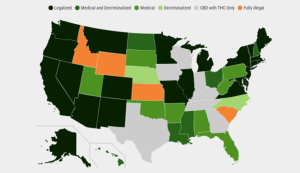
Despite marijuana’s continued federal classification as a Schedule I controlled substance,[1] 26 states and the District of Columbia have passed laws at least partially decriminalizing marijuana possession and recreational use.[2] A majority of Americans now live in states where marijuana is legal for recreational use,[3] and nearly three-quarters of Americans live in states that have legalized marijuana for either recreational or medical sales and use.[4] Currently, 14 states have only legalized medical use,[5] while 24 states and the District of Columbia have implemented regulatory schemes for both medical and recreational use.[6] Of the remaining 12 states where marijuana is still illegal, possession is decriminalized in two states.[7] The map below illustrates these categories.[8]
II. How States Can Change Their Marijuana Laws
Historically, states begin their marijuana policy changes with decriminalization, followed by implementing medical marijuana regulatory programs, and then passing recreational marijuana regulatory programs. The three mechanisms for the implementation of state regulatory programs via marijuana laws are direct legislative action, legislative referrals, and ballot initiatives.
Legislative action is classic representative democracy — bills must pass both chambers[9] and be signed by the governor before they become law. The alternative to representative democracy is direct democracy, in which citizens themselves vote without legislators as proxies. The forms of direct democracy that can change marijuana laws are legislative referrals and ballot initiatives.
A legislative referral means that the legislature places proposed legislation on the ballot to face a popular vote.[10] Every state except Delaware requires legislatures to obtain voter approval to amend their state constitution.[11] In most states, legislatures can also refer state statutes to voters (this is also called a referendum bill).[12]
Like legislative referrals, ballot initiatives also require voter approval, but the initiative process is led by citizens instead of legislators. Citizens can place their proposals on the ballot if enough voter signatures are collected in support of the proposal.[13] Eighteen states allow citizens to initiate state constitutional amendments, and 21 allow initiated state statutes.[14]
III. Methods States Used to Legalize Medical Marijuana
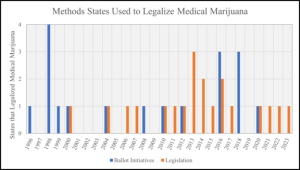
In 1996, California became the first state to permit the use of medical marijuana. Proposition 215, also known as the Compassionate Use Act, was an initiated state statute.[15] The next six states that legalized medical marijuana (Alaska, Nevada, Oregon, Washington, Maine, and Colorado) also did so through ballot initiatives. Since 2000, however, more states have legalized medical marijuana through legislation than through ballot initiatives. Most recently, Kentucky’s legislature passed SB 47, creating a medical marijuana program.[16] Of the 38 states that have legalized medical marijuana, 18 have used ballot initiatives, while 20 have used legislative action. The chart below illustrates these methods over time.
IV. Looking Ahead: Medical
Marijuana remains completely illegal in 12 states (and remains federally illegal). Though time is running out for major change in 2024, several states might pass medical marijuana measures in the near future.
North Carolina: On June 26, North Carolina’s Senate voted to legalize medical marijuana, but the bill faced more opposition in the House.[17] Unfortunately, North Carolina does not allow citizen-initiated ballot measures (or legislatively referred statutes), so direct legislation or a legislatively referred constitutional amendment are the only ways to legalize medical marijuana.[18]
Nebraska: Although Nebraskan voters gathered enough signatures to put medical marijuana on the state’s 2020 ballot, the Nebraska state Supreme Court struck down the initiative.[19] In 2022, Nebraskans failed to collect enough signatures to place the issue on the ballot.[20] This year marks the third attempt at a ballot initiative — advocates met the signature requirements, but it remains to be seen if this attempt will be successful.[21]
Idaho: For the second time, an Idaho political action committee failed to collect sufficient signatures to place medical marijuana legalization measure on the ballot.[22] Idaho is one of the four remaining states where marijuana is not decriminalized, and all marijuana is illegal — the other three states are Kansas, South Carolina, and Wyoming.[23]
South Carolina: Legislators in South Carolina once again let the clock run out on a medical marijuana bill that was introduced in 2022.[24] However, some lawmakers indicated that they might revisit the bill next year.[25]
Wisconsin: In 2025, Wisconsin legislators might revive their efforts to pass a limited medical marijuana bill.[26]
V. Methods States Used to Legalize Recreational Marijuana
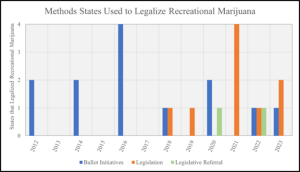
In all 24 states that allow recreational marijuana, recreational legalization occurred after medical legalization, normally with a several-year gap.[27] Colorado and Washington were the first states to legalize recreational marijuana in 2012, 12 and 14 years after they legalized medical marijuana, respectively.[28]
The chart below illustrates when and how states legalized recreational marijuana. In a trend similar to medical marijuana’s timeline, the first nine states to legalize recreational marijuana used ballot initiatives. However, legislatures slowly caught on — nine out of the 15 states that followed legalized recreational marijuana through legislation, while two states put the issue on voters’ ballots through legislative referrals.
VI. Looking Ahead: Recreational
Currently, 14 states permit marijuana for medical use only. In 2024, several of these states made efforts to also allow recreational use. As of June 26, however, the only states that might make that change this year are Florida and South Dakota.
Florida: Florida voters gathered enough signatures to place a recreational marijuana constitutional amendment on their 2024 ballot.[29] This is the state’s fifth attempt to legalize recreational marijuana, and voters must approve it by a 60% supermajority.[30]
South Dakota: South Dakotans approved both medical and recreational marijuana use on the same ballot measure in 2020.[31] However, their state Supreme Court struck down the recreational portion of the measure because state constitutional amendments must cover only one subject.[32] After failing to collect enough signatures for the 2022 ballot, voters met the threshold this year and are waiting on their secretary of state to validate the signatures.[33]
Hawaii: In 2000, Hawaii was one of the earliest states to legalize medical marijuana. In both 2023 and 2024, Hawaii’s Senate approved recreational legalization bills that then died in the state’s House.[34] Of the first 20 states that allowed medical marijuana, Hawaii is the outlier as the only state that has not yet legalized recreational marijuana.[35]
New Hampshire: New Hampshire is the only remaining New England state that has not legalized recreational marijuana.[36] Despite multiple efforts, this year’s legalization bill has been tabled for the following session.[37]
How to Navigate the Illinois Human Rights Act’s Protection of Criminal Convictions
Illinois is one of only a few states that protects conviction records in its anti-discrimination statute. Specifically, the Illinois Human Rights Act prohibits employers from using a conviction record to refuse to hire an applicant or to take an adverse action against an employee. This has led to a number of questions from employers, such as: Does this mean an employer can never terminate an employee or refuse to hire an applicant because of a conviction?
Fortunately for employers, that is not the case. An employer can terminate or refuse to hire based on a criminal conviction, according to Illinois law, if: 1) there is a substantial relationship between the crime and the job or 2) hiring or retaining the convicted worker would create an unreasonable risk to property or safety. However, employers cannot simply decide on their own that one of these factors exists. Employers must complete an interactive process to determine whether a worker’s conviction is worthy of an adverse action.
First, the employer must send the individual notice that their conviction is the reason they may not be hired or may be terminated. The notice must: 1) give a specific reason why the conviction may be disqualifying, 2) provide a copy of any conviction history report the employer relied upon, and 3) give the worker the right to contest the accuracy of the conviction history report or provide evidence of mitigation.
You may notice this sounds much like a Fair Credit Reporting Act pre-adverse action letter, and it does, but the Illinois law goes further than the FCRA because it requires specific reasoning for the decision.
Next, if the worker responds within five business days, the employer must consider all the factors, including:
- The length of time since the conviction
- The number of convictions
- The nature and severity of the conviction and its relationship to others’ safety and security
- The circumstances surrounding the conviction
- The age of the worker at the time of conviction
- Evidence of rehabilitation efforts
If, after this consideration, the employer still intends to refuse to hire or to terminate the worker, it can move to the last step, final notification to the worker. The employer must notify the worker that the conviction is the basis for the adverse decision and must provide the reasoning behind that decision. The employer also must inform the worker of any existing procedure to request reconsideration of the decision and must inform the worker of their right to file a charge with the Illinois Department of Human Rights.
This notification letter is also similar to the FCRA adverse action letter, but again, is more detailed because it requires the employer to detail its reasoning.
The Illinois Human Rights Act has no blanket requirement that employers hire or retain workers with criminal records. However, employers must remember to follow all of these steps and put meaningful thought into why a criminal conviction is disqualifying.
Pennsylvania Amends Data Protection Requirements with Revised Breach Notification Act
On June 28, Pennsylvania took a significant step to enhance its data protection framework by updating the Breach of Personal Information Notification Act through the enactment of SB 824. This new legislation revises the older 2005 law and places a stronger emphasis on the security of digital data. It also introduces more stringent guidelines for notifying consumers and relevant authorities following a data breach.
Under the new law, if a data breach affects more than 500 Pennsylvania residents, entities are required to notify both the impacted individuals and the Pennsylvania Attorney General, as well as consumer reporting agencies, without unreasonable delay. The information provided to the Pennsylvania AG must include the organization’s name and location, the date on which the breach occurred, a brief summary of the incident, and an estimate of the number of affected individuals, both within the state and beyond.
Additionally, the Act mandates that entities bear the expenses related to providing affected individuals with free credit reporting and monitoring services for one year following the breach notification.
The legislation specifies that these obligations are triggered when an entity identifies a security breach and reasonably believes that personal information, such as a person’s name in conjunction with Social Security numbers, bank account numbers, or driver’s license/state ID numbers, have been accessed without authorization.
The law is slated to take effect in 90 days.
Putting It Into Practice: Pennsylvania’s updates to its Breach of Personal Information Notification Act reflect a broader trend among states and federal agencies to address the evolving challenges of data security (see our previous posts on data breach legislation here and here). Businesses subject to the law are now tasked with adapting to these changes swiftly to ensure compliance. In addition, companies facing a breach that spans multiple states must be mindful of how this law, its triggers, and its notification requirements compare to other jurisdictions.
Vermont Employers: Prepare for New Pay Transparency Requirements
Vermont is the newest state to join the pay transparency wave. Effective July 1, 2025, employers will be required to include the compensation or range of compensation in any advertisement of a Vermont job opening. The pay transparency requirements apply to any individual, organization, or governmental entity doing business in Vermont that employs five or more employees.
What must employers do?
For any advertisement of a Vermont job opening, employers must include the compensation or range of compensation for the job opening. An advertisement for a job opening that is paid on a tipped basis must disclose that fact in the advertisement and the base wage or range of base wages for the job.
A “range” means the minimum and maximum compensation or base wage that the employer expects in good faith for the advertised job at the time the employer creates the advertisement. Employers may hire someone for more or less than the range contained in an advertisement based on circumstances outside of the employer’s control, like an applicant’s qualifications or labor market factors.
What is an “advertisement”?
An advertisement is any written notice of a specific job opening that is made available to potential applicants. It does not include: (1) general announcements to notify potential applicants that an employment opportunity may exist without reference to a specific job opening; or (2) verbal announcements of job opportunities.
An advertisement for a job opening that is paid on a commission basis must disclose that fact, but employers are not required to disclose the compensation or range of compensation for that position.
Takeaways
The law requires the Vermont Attorney General’s Office to publish guidance for employers and employees regarding the law by January 1, 2025. Employers should be on the lookout for guidance on the Attorney General’s website.
Vermont now joins states like Minnesota and Maryland that have enacted pay transparency laws this year. Employers should review their advertisement and hiring practices to ensure they comply with the various state transparency laws. Contact your Vorys lawyer with questions regarding pay transparency requirements in jurisdictions in which you operate.
COURT CASES
Lafarge Canada justified in firing worker who refused drug testing: Court decision
According to a ruling made by an Alberta court earlier in June, the construction materials company Lafarge Canada was justified in firing an employee who got into a minor vehicle accident at a worksite and subsequently tested positive for THC.
The incident occurred in June 2022, when the employee, Garry Frederick Quong, worked as a site superintendent and was involved in a minor collision at a worksite; post-incident drug testing revealed that Quong’s THC levels were above Lafarge’s permitted threshold. Although he was offered the opportunity to undergo a substance abuse assessment and participate in a substance abuse program as a condition for his return to work, Quong refused, resulting in his termination by Lafarge later that month.
Quong was employed by Lafarge or a company affiliate for over 40 years, and was the site supervisor at the time of his dismissal.
He filed a wrongful dismissal lawsuit and sought damages of 24 months’ pay plus interest and costs over his dismissal. “Mr. Quong asserts that Lafarge’s Drug and Alcohol Policy is unreasonable and that Lafarge failed to honour the terms of his employment contract which included progressive discipline for infractions rather than immediate escalation to termination,” wrote Justice Colin Feasby in his decision.
The court decision also noted that Lafarge’s approach to the positive drug test made it clear Quong would not have been fired if he had not refused to undergo substance use assessment and participate in a substance abuse program, as per the company’s drug and alcohol policy.
“Faced with an employee who had a positive drug test, Lafarge had no alternative but to insist on compliance with its Drug and Alcohol Policy which I have found to be reasonable,” states the court decision. “Lafarge is required by law to maintain a safe workplace and could not, in the face of a positive drug test, accede to [Quong’s] position that he not be required to participate in the SAP or be subject to random drug testing.”
In addition, the court also rejected Quong’s arguments that Lafarge failed to consider his length of employment history at the company, his age, job performance, seriousness of the incident, and the amount of harm caused to the company. As part of his lawsuit, he argued that his honesty throughout the process and cooperation with the initial drug test should weigh against termination.
“[His] refusal to undergo a substance abuse assessment as part of the SAP prevented Lafarge from meeting its human rights law obligations,” reads the court decision. “The wilful refusal to abide by a policy critical to ensuring a safe workplace is incompatible with continued employment,” the court said, concluding that his behaviour constituted a repudiation of his employment contract.
New Jersey’s attorney general took legal action this week against an employer who allegedly violated state law by discriminating against a medical marijuana patient by rescinding a job offer after he tested positive for THC.
“New Jersey’s civil rights laws require that employers discuss how to develop accommodations that will allow employees with disabilities to perform their duties,” Attorney General Matthew J. Platkin (D) said in a statement. “But this employer cut off all communication, refusing to even try to work with their candidate. Their failure to act violates the law, and we will not tolerate that.”
Platkin’s office said on Tuesday that its Division on Civil Rights issued a finding of probable cause against Delaware-based Prince Telecom. The finding is a precursor to prosecution, though first the case will go to conciliation, where the parties have a chance to settle the matter voluntarily.
The case arose after a job applicant at Prince Telecom completed a drug screening in October 2020. Several days later, according to the finding of probable cause, a human resources representative told him the test came back positive and that Prince was rescinding the job offer.
In response, the applicant told the company he was a registered medical marijuana patient.
“My failed drug test is due to a medical condition which I explained to the medical and testing facility,” he said, according to the five-page complaint. “I believe there are protections afforded me under law. I have never been in this situation before. So, I don’t know what to do at this point. Can someone please reach out to discuss?”
The company’s representative allegedly didn’t respond. About a week afterward, the applicant spoke with the HR director, who allegedly said a second drug test would be necessary. The applicant said that test would also likely come back positive, “because he uses medical marijuana for a medical condition,” the AG’s finding says.
At that point, the company allegedly stopped responding entirely, ignoring a separate letter to Prince’s chairman as well as a later follow-up text message.
Prince later told New Jersey’s Division on Civil Rights that reasonable accommodations for the applicant would be impossible, writing that the cable installation technician position for which he’d been offered a job “is a safety-sensitive position in which the safety risks are further heightened because technicians work alone and are not supervised in the field.”
“There is no reasonable accommodation that would enable Claimant to perform the essential functions of his job,” the company argued. “The only possible accommodations would be to eliminate essential job functions or to pay two technicians to do the job of one, neither of which is reasonable.”
In the new finding, however, the director of the Division on Civil Rights said there’s nevertheless probable cause to believe that Prince Telecom violated anti-discrimination protections.
The state’s medical marijuana law “does make clear that its provisions ‘shall not be construed to permit a person to,’ among other things, ‘operate, navigate, or be in actual physical control of any vehicle, aircraft, railroad train, stationary heavy equipment or vessel while under the influence of marijuana,” the finding document acknowledges. But the statute also “makes it ‘unlawful to take any adverse employment action against an employee who is a registered qualifying patient based solely on the employee’s status as a registrant’ with the Cannabis Regulatory Commission.”
Both the state’s general Law Against Discrimination (LAD) and the state’s specific cannabis-related laws provide certain employment protections to medical marijuana patients.
“Here, there is sufficient evidence to credit Complainant’s allegation that Respondent failed to accommodate his disability in violation of LAD,” says the finding of probable cause. “There is also sufficient evidence to credit Complainant’s allegation that Respondent refused to hire Complainant based on disability.”
“In short, Respondent summarily determined that Complainant’s disability—and the treatment for his disability—automatically disqualified him from employment,” the document continues, noting that the company never provided evidence that the applicant regularly used marijuana during the day. “Accordingly, there is sufficient evidence to conclude that Respondent refused to hire Complainant based on disability.”
Sundeep Iyer, director of the AG office’s Division on Civil Rights, said in a statement that the agency is committed “to ensuring that all employers are aware of their obligations under the law.”
“Our laws provide strong protections against discrimination based on disability. Those protections mean that employers can’t discriminate against employees based on their treatment for a disability, including their use of marijuana to treat or alleviate the symptoms of a disability,” he said.
The press release from Platkin’s office notes that not only LAD but also the state’s medical and adult-use cannabis laws protect job applicants from discrimination.
“Under the Jake Honig Compassionate Use Medical Cannabis Act, employers cannot take adverse employment action against an employee based on the fact that the employee is registered as a medical marijuana user with the Cannabis Regulatory Commission,” it says. “And under the Cannabis Regulatory, Enforcement Assistance, and Marketplace Modernization Act (CREAMMA), an employee or applicant cannot be subject to adverse action by an employer solely due to a positive drug test for cannabis.”
Platkin’s office noted, however, that CREAMMA was passed after the incident involving Prince Telecom, meaning it does not apply in the current dispute.
The attorney general has taken a comparatively bold approach to protecting employment protections for legal cannabis users in New Jersey. In 2022, Platkin told law enforcement officials statewide that state law does not allow them to fire police officers who use cannabis off duty—a decision that led to a lawsuit from local Jersey City officials. A police union has asked for the suit to be dismissed, called it “pure hogwash.”
Platkin revised that guidance the following year, generally barring screenings for marijuana in most circumstances following the state’s enactment of legalization.
Last November, meanwhile, a separate lawsuit from two Jersey City police officers who were fired for testing positive for marijuana claimed that the city’s policy of punishing law enforcement for off-duty cannabis use is merely an effort by Mayor Steven M. Fulop (D) to “win over more conservative voters needed for his gubernatorial campaign.”
Back in 2019, a former Amazon warehouse employee filed suit against the corporate behemoth, alleging that he was terminated after testing positive for THC and subsequently requesting a disability accommodation for his anxiety disorder to allow him to use cannabis in accordance with state law.
INTERNATIONAL DEVELOPMENTS
New Data Flow Agreement Between the EU and Japan Enters into Force
On July 1, 2024, a new agreement between the EU and Japan facilitating data flows between the two jurisdictions (the “Data Flow Agreement”) entered into force. The Data Flow Agreement was concluded in October 2023 and will be incorporated into the text of the EU-Japan Economic Partnership Agreement.
The Data Flow Agreement aims to limit digital protectionism between the two economic blocs that may result from measures such as data localization requirements or prohibitions on storage/transfers of information to other jurisdictions.
The European Commission expects that the Data Flow Agreement will bring benefits to companies active across most sectors, including financial services, transport, machinery and e-commerce.
The focus of the Data Flow Agreement is non-personal data. Japan already benefits from an Adequacy Decision from the European Commission and the Data Flow Agreement does not prevent Japan or the EU from regulating cross-border transfers of personal data.
Read the press release and the Data Flow Agreement.
Cross-border transfers of personal information outside Québec: Requirements for businesses
The Québec Act respecting the protection of personal information (the ARPPIPS), provides significant obligations when communicating personal information outside Québec (specifically, the sharing of information or the granting of remote access, both of which we will refer to as transfers), whether the transfers are to a service provider or to some other category of third party. In this article, we describe the Québec framework governing international and interprovincial transfers of personal information, and provide compliance tips to organisations.
Legal framework applicable to transfers of personal information
Since September 22, 2023, an obligation of transparency, set out in paragraph 2 of section 8 of the ARPPIPS, requires organizations to notify the person concerned, at the time of collection and subsequently on request, of the possibility that the information collected may be communicated outside Québec.
This notification is usually done by the organization in its customer- and employee-facing privacy policies.
Furthermore, section 17 modifies the framework governing transfers and imposes additional requirements on organizations to ensure an adequate level of protection for information transferred outside the province.
In order for a transfer to be authorized by the ARPPIPS, the exporting organization needs to conduct a privacy impact assessment in relation to the proposed transfer (a Transfer Impact Assessment, or TIA). It must then ensure that the protective measures in place will adequately protect the exported information. These measures must include a written contract with the entity receiving the information.
Transfer impact assessments
An organization that (1) wishes to communicate personal information outside Québec or (2) entrusts a third party outside Québec with the task of collecting, using, releasing or keeping personal information on its behalf must carry out, prior to the transfer, a TIA that takes the following factors into account:
- the sensitivity of the information;
- the purposes for which it is to be used;
- the protective measures, including the contractual measures, that would apply to the information; and
- the legal framework applicable in the State in which the information will be communicated, including the personal information protection principles applicable in that State.
This last factor may raise several questions since the ARPPIPS does not define what those “generally recognized principles regarding the protection of personal information” are.
However, the Québec privacy regulator, the Commission d’accès à l’information (CAI) published some guidance on this specific point, buried in its Guide on Conducting a Privacy Impact Assessment. The CAI remained cautious and indicated that it can be assumed that these “recognized principles” are general rules designed to ensure the protection of personal information, as well as the respect for the rights and interests of the persons concerned in this area [our translation]. The CAI also provided a non-exhaustive and non-definitive list of those principles inspired from (among others) the OECD Privacy Guidelines, the U.S. Federal Trade Commission’s Fair Information Practice Principles (FIPPs), Canada’s federal Personal Information Protection and Electronic Documents Act, and the European Union’s General Data Protection Regulation.
In order to enhance their compliance with the assessment obligations set out in section 17 of the ARPPIPS, we recommend that organizations ensure that their PIA model allows for the evaluation of the following principles:
- Accountability: organizations are accountable for their management of personal information.
- Identifying purposes: the purposes for which personal information is collected are identified prior to collection.
- Limiting collection: organizations collect only the information necessary for the purposes identified. Information is collected by fair and lawful means.
- Consent: persons concerned are adequately informed of the identified purposes and freely consent to them unless an exception applies.
- Protection by design and default: products/services are designed with respect for the privacy of persons concerned. If they include privacy settings, these protect privacy by default.
- Limiting use, disclosure and retention: organizations use and disclose personal information collected for identified purposes or compatible purposes, except with consent or legal exception.
- Accuracy: organizations keep personal information up to date and ensure that it is accurate and complete at the time it is used or disclosed.
- Security: organizations take appropriate security measures to protect the information they hold at all times against loss, theft or unauthorized modification, disclosure or destruction.
- Transparency: organizations provide relevant information to data subjects at the time of collection or consent.
- Data subject rights: persons concerned can access their personal information and request rectification or, in certain cases, deletion.
- Remedies: in the event of dissatisfaction, people can contest a refusal to exercise a right or lodge a complaint with the organization or a competent body.
Implementation of protective measures, including contractual measures
Section 17 of ARPPIPS also requires that the TIAs take into account the protective measures, including the contractual measures, that would apply to the transfer of personal information. The Québec legislator has indeed chosen to rely mainly on contractual safeguards when it comes to providing an adequate level of personal information protection. In this regard, a distinction should be made between transfers to service providers (who can use the information solely on behalf and for the benefit of their client) and transfers to other third parties.
Service providers
Where the transfer is to a service provider, section 18.3 of the ARPPIPS requires that a written contract be entered into and that it:
- specifies the measures that the service provider must take to protect the confidentiality of the transferred personal information, to ensure that the information is used only for carrying out the mandate or performing the contract, and to ensure that the service provider does not keep the information after the expiry of the contract;
- states that the service provider must notify the person in charge of the protection of personal information (e.g., the privacy officer of the client company), without delay, of any violation or attempted violation by any person of any obligation of confidentiality; and
- states that the person in charge of the protection of personal information must be permitted to carry out any verifications relating to the service provider’s confidentiality obligations.
In addition to these provisions specific to service contracts, the contract must take into account the results of the TIA. If, based on the TIA, it can be concluded that the information processed abroad by a service provider will be sufficiently protected with a contract that simply incorporates the requirements of section 18.3, no other measure will be necessary for the transfer to proceed.
If, however, the TIA indicates that processing abroad poses a risk for the protection of the information, the parties must, in their contract, implement and document measures that reduce the risk to an adequate level. In our view, technical measures (such as encryption and depersonalization) and organizational measures (such as corporate policies restricting the sharing of information with foreign government authorities) should be considered.
Other recipients
Although the ARPPIPS does not impose any specific contents for contracts applicable to the sharing of information with third parties outside Québec that are not acting as service providers providers such as affiliates that intend to use the data for their own purposes, we believe the following obligations flow from the requirements of section 17:
- a written contract must be entered into with each such recipient;
- the contract must provide an adequate level of protection for the transferred information by incorporating, among other things, the obligations stemming from the OECD Principles (limited collection, data quality, purpose specification, use limitation, protection safeguards, openness, individual participation, and accountability); and
- the parties must take into account the results of the TIA and, if applicable, put in place measures to reduce to an adequate level the risks associated with the foreign legal regime. This analysis should use the same criteria that are used in the context of a transfer to a service provider.
Differences with the federal framework
While the Personal Information Protection and Electronic Documents Act (PIPEDA) does not explicitly require that organizations notify individuals that their personal information may be transferred outside of Canada, the Office of the Privacy Commissioner of Canada (OPC) published in 2009 its Guidelines for processing personal information across borders, in connection with PIPEDA. The guidelines require organizations that transfer personal information for processing purposes to provide, by contractual or other means, “a comparable level of protection while the information is being processed by the third party.” Such organizations are also subject to an obligation of transparency, which requires them to notify the individuals concerned that information is being transferred outside Canada, and that there is a risk foreign authorities may access it.
The expected PIPEDA reform bill introduced by the federal government in June 2022 (Bill C-27) and currently under review by the Standing Committee on Industry and Technology, imposes, for the moment, an obligation of transparency with regard to international and interprovincial transfers. If adopted, as is, the organization’s external privacy policy will need to specify whether or not it will carry out any international or interprovincial transfer or disclosure of personal information that may have “reasonably foreseeable privacy implications” (Bill C-27, s. 62(2)(d)). This requirement comes on top of the outsourcing obligations, which provide, among other things, that the organization must ensure, contractually or by other means, that the service provider offers a level of protection equivalent to what the organization is required to offer for such personal information under Bill C-27.
Compliance tips
Organizations should put in place the following measures to comply with the requirements of ARPPIPS with respect to transfers of personal information outside Québec:
- Map out the flows of personal information, the jurisdictions to which such information will be exported, and the categories of recipients who will import and process such information.
- Develop a TIA model that allows for the analysis of the legal frameworks of the importing jurisdictions having regard to the generally recognized principles.
- Identify the jurisdictions where the organization will be transferring personal information. If their legal regime risks contravening the generally recognized principles, assess whether contractual, organizational and technical measures could reduce the risk to an acceptable level by providing adequate protection for the transferred information.
- Ensure that the relevant contracts include personal information transfer clauses that comply with the ARPPIPS requirements, having regard to the circumstances under which the transfers are to be made.
Brazil’s Supreme Court decriminalizes possession of marijuana for personal use
All the justices who have voted in favour said decriminalization should be restricted to possession of marijuana in amounts suitable for personal use. Selling drugs will remain illegal.
In 2006, Brazil’s Congress approved a law that sought to punish individuals caught carrying small amounts of drugs, including marijuana, with alternative penalties such as community service. Experts say the law was too vague and didn’t establish a specific quantity to help law enforcement and judges differentiate personal use from drug trafficking.
Police continued to arrest people carrying small quantities of drugs on trafficking charges and Brazil’s prison population continued to swell.
“The majority of pre-trial detainees and those convicted of drug trafficking in Brazil are first-time offenders, who carried small amounts of illicit substance with them, caught in routine police operations, unarmed and with no evidence of any relationship with organized crime,” said Ilona Szabo, president of Igarape Institute, a think tank focusing on public security.
Congress has responded to the top court’s ongoing deliberations by separately advancing a proposal to tighten drug legislation, which would complicate the legal picture surrounding marijuana possession.
In April, the Senate approved a constitutional amendment criminalizing possession of any quantity of illicit substance. The lower house’s constitutional committee approved the proposal on June 12, and it will need to pass through at least one other committee before going to a floor vote.
If lawmakers pass such a measure, the legislation would take precedence over the top court’s ruling but still could be challenged on constitutional grounds.
Speaking to reporters in capital Brasilia, the Senate’s president, Rodrigo Pacheco, said it isn’t the Supreme Court’s place to issue a decision on the matter.
“There is an appropriate path for this discussion to move forward and that is the legislative process,” he said. “It is something that, obviously, arouses broad discussion and it is a subject of preoccupation for Congress.”
Last year, a Brazilian court authorized some patients to grow cannabis for medical treatment after the health regulator in 2019 approved guidelines for the sale of medicinal products derived from cannabis. But Brazil is one of a few countries in Latin America that hasn’t decriminalized the possession of small quantities of drugs for personal consumption.
The Supreme Court’s ruling has long been sought by activists and legal scholars in a country where the prison population has become the third largest in the world. Critics of current legislation say users caught with even small amounts of drugs are regularly convicted on trafficking charges and locked up in overcrowded jails, where they are forced to join prison gangs.
“Today, trafficking is the main vector for imprisonment in Brazil,” said Cristiano Maronna, director of JUSTA, a civil society group focusing on the justice system.
Brazil ranks behind U.S. and China in countries with the highest prison populations, according to the World Prison Brief, a database tracking such figures.
Some 852,000 individuals were deprived of liberty in Brazil as of December 2023, according to official data. Of those, nearly 25 per cent were arrested for possession of drugs or trafficking. Brazilian jails are overcrowded, and Black citizens are disproportionately represented, accounting for more than two-thirds of the prison population.
A recent study by Insper, a Brazilian research and education institute, determined that Black individuals found by police with drugs were slightly more likely to be indicted as traffickers than white people. The authors analyzed over 3.5 million records from Sao Paulo’s public security secretariat from 2010 to 2020.
“An advance in drug policy in Brazil! This is an issue of public health, not security and incarceration,” leftist lawmaker Chico Alencar wrote on X after the ruling.
By contrast, Gustavo Scandelari, a specialist on Brazil’s penal code at law firm Dotti Advogados, said he doesn’t foresee the ruling bringing about a significant shift from the status quo, even after the top court establishes a maximum quantity of marijuana for personal use. Scandelari argued that the amount will remain one determinant of whether authorities consider a person a dealer or a user, but not the only one.
Some Brazilians, like 47-year-old Rio de Janeiro resident Alexandro Trindade, have managed to be upset with both the Supreme Court decriminalizing marijuana and Congress pushing to keep it illegal.
“The Supreme Court is not the right place (for such decision). This should be submitted to a plebiscite for the people to decide,” Trindade said. “Both the Supreme Court and Congress have been very opposed to society in this.”
As in other countries in the region, like Argentina, Colombia and Mexico, medicinal use of cannabis in Brazil is allowed, though in a highly restricted manner.
Uruguay has fully legalized the use of marijuana, and in some U.S. states recreational use for adults is legal. In Colombia, possession has been decriminalized for a decade, but a law to regulate the recreational use of marijuana so that it can be sold legally failed to pass in the Senate in August. Colombians can carry small amounts of marijuana, but selling it for recreational purposes is not legal.
The same goes for Ecuador and Peru. Both distribution and possession remain illegal in Venezuela.
Argentina’s Supreme Court ruled in 2009 it was unconstitutional to penalize an adult for consuming marijuana if it didn’t harm others. But the law has not been changed and users are still arrested, although most cases are thrown out by judges.
Uruguay became the first country to legalize marijuana for recreational use in 2013 although it was only implemented in 2017. Uruguay’s whole industry, from production to distribution, is under state control and registered users can buy up to 40 grams of marijuana per month through pharmacies.
Brazil’s Supreme Court on Tuesday voted to decriminalize possession of marijuana for personal use, making the nation one of Latin America’s last to do so, in a move that could reduce its massive prison population.
With final votes cast on Tuesday, a majority of the justices on the 11-person court have voted in favour of decriminalization since deliberations began in 2015.
The justices must still determine the maximum quantity of marijuana that would be characterized as being for personal use and when the ruling will enter into effect. That is expected to finish as early as Wednesday.
MISCELLANEOUS DEVELOPMENTS
10 social media tips for employers and employees
Want to stay out of trouble? Read on!
Did you know that this Sunday will be “Social Media Day”? Neither did I.
But even after all this time, social media continues to get employees and employers in trouble. Here are six tips for employees, followed by four tips for employers. (That adds up to 10.) Following these tips may not always keep you out of hot water, but they’ll certainly help you stay cool.
Social media tips for employees
No. 1: Know your rights (or lack thereof). You may have heard of the First Amendment and how it guarantees freedom of speech. That is kind of true, but it’s also misleading because the First Amendment doesn’t shield you from all repercussions from what you say. For example, if you post on Facebook that your boss is an idiot, and your boss sees it and gets mad, your boss can fire you without violating the First Amendment, right? Right. The First Amendment protects you from having the government throw you in jail for expressing your opinions. But it won’t protect you from losing friends, facing social backlash, or even losing your job because of what you say, so post accordingly. (If you work for the government, you have more First Amendment protections than private sector employees, but even then your rights are not unlimited.)
No. 2: Steer clear of political debates. If you enjoy posting about politics, watch out, especially in today’s climate. Regardless of what you say, political posts are likely to upset half of your friends or followers. Or maybe that’s just me — I live in a swing state. Some individuals might react so strongly to your views that they could stop being your friends, or cause even more serious problems for you.
No. 3: Don’t post about sex or illegal activity. If you must share about sex or illegal activities, avoid doing it on social media. Inquiring minds don’t want to know. (Posting about sex could be deemed sexual harassment if seen by co-workers who are offended. Which leads to the next point…)
No. 4: If you must overshare, unfriend or block all of your co-workers first. If you just can’t resist posting something risky/risque, then unfriend or block your co-workers first and crank up those privacy settings as far as they will go. But it’s still better not to post that type of content at all. If you post with precautions, someone might still find your post, take offense, and report you to your employer.
No. 5: You have the right to remain silent. Anything you say can and will be used against you in the workplace. Always assume that your social media posts could come back to haunt you. Employers (current and prospective) and online vigilantes are always watching.
No. 6: On the other hand, boring is good. If your posts are about cute babies, the buffet at the Golden Corral where you ate the other night, your adorable Labradoodle Maximus, and happy birthday wishes to your friends (but nothing about their ages!), you’re probably in the clear. For now.
Social media tips for employers
No. 7: Understand your rights. Generally, you have the right to act against an employee for inappropriate social media posts that offend co-workers, disparage your business, disclose confidential information, or damage your company’s reputation. You can also take action based on posts that are discriminatory or harassing based on race, sex (including sexual orientation and gender identity), national origin, religion, age, or disability, and against employees who communicate threats via social media or who post about their illegal activities.
If you are an employer in the health care industry, you can also take action to prevent and address (when it occurs) postings that may violate the privacy rights of patients or their families.
No. 8: Seek legal advice. Always consult with your labor or employment counsel before acting. Posts related to terms and conditions of employment may be considered “protected concerted activity” under the National Labor Relations Act, making it potentially unlawful to act against the employee. This applies even to non-union companies, and even a simple “Like” could be protected.
No. 9: Ignorance is bliss. Prohibit, or at least strongly discourage, your managers and supervisors from being “friends” or “contacts” with employees on social media. Otherwise, they might learn more about their employees than they really need or want to know. For example, that Jane is taking anti-depressants. Or that Joe belongs to a bizarre religious cult. Ignorance can be bliss—and it can also be a defense against discrimination claims. (You can’t discriminate against someone based on a protected characteristic if you don’t even know about that characteristic.)
No. 10: Be fair and consistent. Hold all “similarly situated” employees to the same standards of conduct that apply to social media. You may need to be stricter with higher-ups who violate your policy.
A little caution and common sense can go a long way in preventing a social media disaster. Stay smart, stay cool, and keep those posts drama-free!
US Department of Labor Announces Final Rule Increasing Salary Thresholds for Overtime Exemptions
On 3 July 2024, the Northern District of Texas preliminarily enjoined the US Federal Trade Commission from implementing and enforcing its Final Rule banning non-competes against the US Chamber of Commerce, the Business Roundtable, the Texas Association of Business, the Longview Chamber of Commerce, and Ryan LLC, thereby staying the effective date of the Final Rule until the court issues its ruling on the merits, expected on or before 30 August 2024.
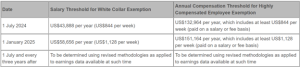
On 23 April 2024, the US Department of Labor (DOL) announced a Final Rule raising the minimum salary and annual compensation thresholds to qualify for the executive, administrative, or professional (White Collar) exemptions from overtime under the Fair Labor Standards Act (FLSA). The Final Rule also increased the salary requirements for the highly compensated employee exemption (HCE Exemption). Under the Final Rule, an initial increase in salary thresholds will take effect on 1 July 2024, and a full increase to the thresholds takes effect on 1 January 2025. Further, the Final Rule introduces changes in the methodologies used to calculate and periodically update these salary thresholds to reflect current earnings data, which employers can expect to be applied every three years.
If the Final Rule becomes effective, employers will need to increase the salaries of any employee treated as exempt under the White Collar and HCE exemptions in order to maintain their exempt status. This Final Rule, however, is predicated on a methodology found invalid in 2016 (which is discussed in this K&L Gates alert) and is likely to face legal challenges.1
BRIEF OVERVIEW OF THE WHITE COLLAR AND HIGHLY COMPENSATED EXEMPTIONS
Under the FLSA,2 covered employers generally must pay employees a minimum wage and overtime pay of at least 1.5 times the employee’s regular rate of pay for hours worked over 40 hours in a given workweek.3 The FLSA carves out certain exemptions to the overtime rule based on an employee’s job duties and salary. One such exemption includes employees “employed in a bona fide executive, administrative, or professional capacity,”4 commonly known as the White Collar exemption. Those employees must (1) receive a salary that is equal to or greater than the salary threshold set by the DOL (currently $684 per week) and is not based on the amount of hours worked or quality of work performed; and (2) primarily perform executive, administrative, or professional duties as defined by the DOL.
Another exemption from the overtime rule is the HCE exemption. To qualify for that exemption, the employee must (1) be paid total annual compensation in excess of a set salary threshold (currently $107,432), which includes at least the minimum weekly basis of the White Collar exemption; (2) have a primary duty that includes performing office or nonmanual work; and (3) customarily and regularly perform at least one of the exempt duties or responsibilities outlined in the White Collar exemption.
WHAT DOES THE NEW RULE CHANGE?
The Final Rule significantly increases the salary and annual compensation thresholds to qualify for an exemption from overtime pay under the FLSA’s White Collar or HCE exemptions. However, it does not change the job duties requirements of the White Collar or HCE exemptions.
The Final Rule also revises the methodologies used to calculate these thresholds to include US Census salary data and, thus, reflect earnings growth, and requires that the thresholds be automatically adjusted using this methodology every three years. This is a significant change from prior rules, which allowed threshold increases only through formal rulemaking. Pursuant to the Final Rule, every three years, the DOL will consider the US Census salary data and update the salary thresholds.
Under the Final Rule, an initial increase to these thresholds will take place on 1 July 2024. The full increase calculated under the updated methodologies will take place on 1 January 2025.
The scheduled increases are as follows:
LOOKING AHEAD
What should employers do to prepare? Employers should monitor the Final Rule so they are aware of any legal challenges or other developments that may impact the effective dates or terms of the Final Rule. At the same time, employers should analyze the compensation of their workforce to determine whether they need to increase exempt employees’ salaries so they do not forfeit their exempt status when the Final Rule takes effect, or alternatively, convert them to nonexempt employees. Employers should also ensure that they implement internal procedures so they may be in compliance prior to the automatic salary increases set forth in the Final Rule. If employers fail to take action to increase salaries in advance of the effective date, exempt employees may lose their exemption and be subject to the overtime and recordkeeping requirements of the FLSA. A failure to comply with these provisions can result in significant penalties under the FLSA as well as under state wage payment laws.
Updated EEOC Guidance Provides Employers With Roadmap to Refresh Harassment Policies and Trainings
With nearly fifty years of caselaw addressing the introduction, definition, and expansion of workplace harassment law, the Equal Employment Opportunity Commission (EEOC) replaced its prior enforcement guidance published in the 1980s and 1990s with a new document entitled “Enforcement Guidance on Harassment in the Workplace.” The document includes many practical examples of types of harassment and explanations of employer liability and causation. It also provides some helpful insight that employers can use to review and update their harassment policies and trainings. While some aspects of the guidance pertaining to gender identity are currently facing legal challenge, the guidance remains in effect and the tips below are grounded in established case law, providing a solid roadmap for employers to follow.
When Less Is Not More — Is Your Policy Broad Enough?
Even before the EEOC’s April 29, 2024, release of its new enforcement guidance, one of the most common errors in employer anti-harassment policies was having too narrow of a scope for prohibited behavior. What do we mean by scope? In a typical employee handbook, employers often include an Equal Employment Opportunity policy that covers federal, state, and local protected classes; however, often the Harassment policy focusses only on sexual harassment. While it is true that the bulk of litigation and coverage of harassment cases involve sexual harassment, that does not mean there cannot be harassment based on other protected classes such as race, color, national origin, age, disability, religion, or other protected classes, for example. If behavior is not covered by your policy, how will your employees know their rights and responsibilities?
It is important that your policies inform employees of all prohibited behavior and also the internal complaint procedures to address such behavior in the workplace. First, internal complaints are the best way for you to learn about and correct prohibited behavior, rather than first hearing of the concerns through an administrative agency, an attorney demand letter, or a lawsuit. But more importantly, courts hearing claims of workplace harassment will look to see if the employer exercised reasonable care both to prevent and to correct workplace harassment. In fact, this standard has long been part of the caselaw with respect to determining employer liability and also the availability of affirmative defenses. Employer policies and accompanying education programs can be used to meet these obligations along with a responsive complaint resolution process.
Tips for Implementing Policies, Procedures, and Education Programs
While there is no magic language to guarantee your policy, complaint procedures, and trainings will pass legal muster, the focus will be on what is reasonable. Therefore, try to put yourself in your various employees’ shoes: How will they know what behavior is prohibited? How will they know when and where to turn for help?
In its recent guidance, the EEOC lists some general expectations of an effective policy:
- Define what conduct is prohibited. Be sure that your policy covers all forms of protected classes — including local laws and ordinances that are often broader than state and federal law — so that you can identify all potential claims of harassment.
- Disseminate your policy to all employees, track its delivery/receipt.
- Make sure the policy is understandable to all your workers, including those who may face literacy or language challenges. Be careful of form policies from the web or associations that may not fit your workforce.
- Require that supervisors report harassment when they become aware of it.
- Offer a bypass or multiple avenues for reporting harassment so the employee is not required to contact their harasser to report the concern.
- Clearly identify points of contact where reports of harassment should be made and include contact information.
- Explain the complaint process, including anti-retaliation and confidentiality protections.
The guidance similarly offers suggestions for an effective complaint resolution process:
- Make sure the process provides for prompt and effective investigations and corrective action reasonably aimed at stopping the behavior.
- Offer confidentiality protections to the extent you can.
- Provide and enforce adequate anti-retaliation protections.
Employers should be careful with promises of confidentiality. While it is certainly helpful to create an environment in which employees feel comfortable coming forward, confidentiality provisions are not meant to unnecessarily restrict the employer’s ability to investigate and take corrective action to stop prohibited behavior. A good policy explains the extent and limitation to which the employer can protect confidentiality for employees coming forward before they disclose information that requires some form of a response.
Finally, training and awareness programs need to both (i) explain employee’s rights to be free from harassment and how to seek assistance and (ii) instruct employees of their responsibilities, especially with respect to supervisors who will often play a role in the complaint resolution process if they learn of prohibited behavior. The EEOC offers the following tips for an effective education program:
- Explain the anti-harassment policy and complaint process, including any alternative dispute resolution process, and confidentiality and anti-retaliation protections.
- Describe and provide examples of prohibited conduct under the policy.
- Provide information about employees’ rights if they experience, observe, become aware of, or report conduct they believe may be prohibited.
- Provide supervisors and managers with information about how to prevent, identify, stop, report, and correct harassment with clear instructions for addressing and reporting harassment that they observe, that is reported to them, or that they otherwise become aware of.
- Tailor the program to the workplace and workforce in a clear and easy to understand style and format.
- Provide training on a regular basis to all employees.
Common Mistakes
Despite planning and best intentions, harassment cases can be difficult to administer. One common omission from harassment policies includes behavior that comes from clients, vendors, or other third parties with whom the employee must encounter as part of their job responsibilities so that employees know it is prohibited and can be reported.
A common misunderstanding the EEOC highlights is that “intraclass harassment” is also covered; that is, behavior can still constitute harassment even if the harasser and the targeted employee share the same protected class — the only question is whether the behavior was directed at the employee because of their protected class.
Next, we often see policies suggesting the employee confront the harasser first to see if the problem can be resolved. While this option is permissible, it is important that the tone of the policy, as well as the culture of the organization, support the notion that this option must be voluntary and not otherwise thwart an employee’s use of your complaint resolution process to address concerns.
Finally, if your company has an ethics hotline or similar reporting mechanism, be sure someone is trained in how to respond to complaints of harassment that may come through that system, including anonymous complaints.
Takeaways
It is worth noting that there are many novel legal applications in the EEOC document and, not surprisingly, there are currently several legal challenges to certain aspects of the new guidance making their way through the courts specific to gender identity and sexual orientation, for example. In addition, recent activity by the U.S. Supreme Court has altered the legal application of guidance such as this. However, the steps and actions identified above are sound areas to review that will not be affected by the isolated challenges.
CFPB Issues Circular, Warning Against Whistleblower Intimidation
On July 24, 2024, the CFPB issued a circular detailing how companies may be breaking the law by requiring employees to sign broad nondisclosure agreements that could deter whistleblowing.
Under Section 1057(a) of the Dodd-Frank Act, covered persons are prohibited from terminating or otherwise discriminating against covered employees for engaging in whistleblowing activity. The term “discriminate against” encompasses a variety of adverse actions that a covered person may take against employees.
The Bureau notes that while confidentiality agreements can be entered into for legitimate purposes, such as ensuring the protection of trade secrets, they can also be worded and employed in such a way that could lead an employee to reasonably believe that they would be subject to adverse actions if they disclosed information related to suspected violations of law to government investigators. The circular states that certain confidentiality agreements may forbid the sharing of information with outside parties, with no acknowledgment of, and exception for, the exercise of whistleblower rights. A reasonable employee, who is aware of an internal or government investigation into malfeasance, may interpret their required entry into such an agreement as a threat against reporting information to the government.
The circular states that even if a company’s confidentiality agreement accounts for whistleblowers, the language may not be clear, or it might be confusing. For example, an agreement that forbids sharing information with third parties “to the extent permitted by law” may technically allow whistleblowing; however, an employee, who may not know that the law forbids restrictions on whistleblowing but understands that violating the agreement could lead to adverse employment actions, might reasonably interpret the agreement as prohibiting information to a law enforcement agency or voluntarily cooperating in a government investigation.
The circular offers some guidance. It states that an employer can significantly reduce its risk of violating Section 1057 by ensuring that its agreements explicitly allow employees to communicate freely with government enforcement agencies and to cooperate in government investigations.
Putting it into Practice: The CFPB’s circular serves as a policy statement under the Administrative Procedure Act. Although it does not “impose any legal requirements on external parties,” the circular communicates the Bureau’s interpretation of the law and indicates how it intends to proceed with supervisory and enforcement actions.
© 2024 ClearStar. All rights reserved. – Making copies of or using any part of the ClearStar website for any purpose is prohibited unless written authorization is first obtained from ClearStar. ClearStar does not provide or offer legal services or legal advice of any kind or nature. Any information on this website is for educational purposes only.
Let's start a conversation

At ClearStar, we are committed to your success. An important part of your employment screening program involves compliance with various laws and regulations, which is why we are providing information regarding screening requirements in certain countries, region, etc. While we are happy to provide you with this information, it is your responsibility to comply with applicable laws and to understand how such information pertains to your employment screening program. The foregoing information is not offered as legal advice but is instead offered for informational purposes. ClearStar is not a law firm and does not offer legal advice and this communication does not form an attorney client relationship. The foregoing information is therefore not intended as a substitute for the legal advice of a lawyer knowledgeable of the user’s individual circumstances or to provide legal advice. ClearStar makes no assurances regarding the accuracy, completeness, or utility of the information contained in this publication. Legislative, regulatory and case law developments regularly impact on general research and this area is evolving rapidly. ClearStar expressly disclaim any warranties or responsibility or damages associated with or arising out of the information provided herein.

